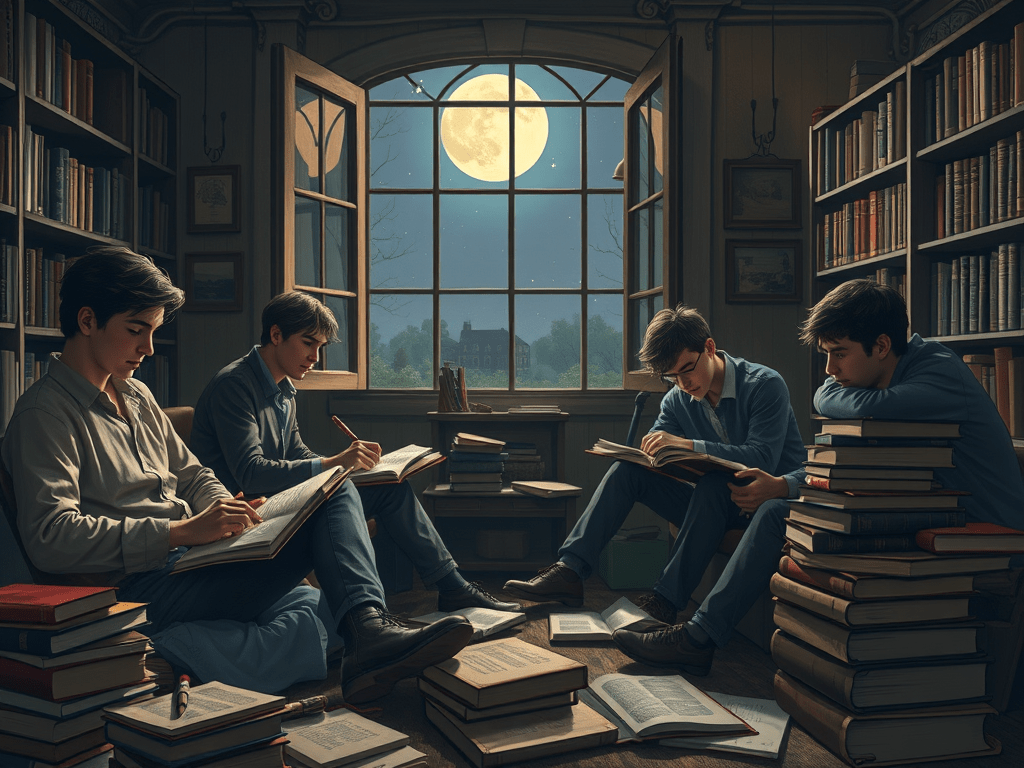
As you may know, I have been creating song from poems on the public domain. I have been choosing different poets over the last couple of months for song creation in Suno ai music generator.
This time I chose Stephen Vincent Benet. According to Wikipedia . He lived from July 22, 1898 to March 13, 1943. He was an American poet and short story writer. He is probably most notable for “The Devin and Daniel Webster” in 1936, and he also wrote “Seven Brides for Seven Brothers.”
After looking at all his poems on the public domain, I came across these four sonnets. They are called the Campus Sonnets and they tell a story. Now I could go to ChatGPT and tell you what ChatGPT thinks but I think you may want to know what I think and not some AI computer. So here it goes – here is my interpretation for each sonnet and also links to the songs I created in Suno to tell the story. And after listening to them all, you may hear the same chorus. Each of them sung differently but I think the chorus ties all four sonnets together.
Campus Sonnet 1: Before An Examination
The little letters dance across the page,
    Flaunt and retire, and trick the tired eyes;
    Sick of the strain, the glaring light, I rise
    Yawning and stretching, full of empty rage
    At the dull maunderings of a long dead sage,
    Fling up the windows, fling aside his lies;
    Choosing to breathe, not stifle and be wise,
    And let the air pour in upon my cage.

    The breeze blows cool and there are stars and stars
    Beyond the dark, soft masses of the elms
    That whisper things in windy tones and light.
    They seem to wheel for dim, celestial wars;
    And I -- I hear the clash of silver helms
    Ring icy-clear from the far deeps of night.
In this sonnet, Stephen Benet is speaking from the point of view of being a college student. I was a college student once so I can relate. He puts it into verses that reflect studying for an exam. It is about how hard it is to study. Pulling an all nighter. It is about trying to cram a whole semesters worth of information into six to eight hours before the final exam. I believe the pictures in the video for the song captures how it feels to study all night.
Campus Sonnet 2: Talk
Tobacco smoke drifts up to the dim ceiling
    From half a dozen pipes and cigarettes,
    Curling in endless shapes, in blue rings wheeling,
    As formless as our talk. Phil, drawling, bets
    Cornell will win the relay in a walk,
    While Bob and Mac discuss the Giants' chances;
    Deep in a morris-chair, Bill scowls at "Falk",
    John gives large views about the last few dances.

    And so it goes -- an idle speech and aimless,
    A few chance phrases; yet I see behind
    The empty words the gleam of a beauty tameless,
    Friendship and peace and fire to strike men blind,
    Till the whole world seems small and bright to hold --
    Of all our youth this hour is pure gold.
This sonnet is all about being social. It is about making memories with your friends. The discussions and friends make us happy and make the whole college experience worth it. Did I have this kind of experience? My answer is No. I was already married with a child so having late night conversations and shooting the bull was not something I was privy to.
Campus Sonnet 3: May Morning
I lie stretched out upon the window-seat
    And doze, and read a page or two, and doze,
    And feel the air like water on me close,
    Great waves of sunny air that lip and beat
    With a small noise, monotonous and sweet,
    Against the window -- and the scent of cool,
    Frail flowers by some brown and dew-drenched pool
    Possesses me from drowsy head to feet.

    This is the time of all-sufficing laughter
    At idiotic things some one has done,
    And there is neither past nor vague hereafter.
    And all your body stretches in the sun
    And drinks the light in like a liquid thing;
    Filled with the divine languor of late spring.
These verses seem to me to relive a morning after studying all night. The first sonnet is about studying for the exams. The second sonnet is about taking a break from studying and being with friends, so this sonnet is about the morning after. I think it about the morning after partying. I want to say I can relate – but I won’t.
Campus Sonnet 4: Return – 1917
"The College will reopen Sept. --." `Catalogue'.


    I was just aiming at the jagged hole
    Torn in the yellow sandbags of their trench,
    When something threw me sideways with a wrench,
    And the skies seemed to shrivel like a scroll
    And disappear... and propped against the bole
    Of a big elm I lay, and watched the clouds
    Float through the blue, deep sky in speckless crowds,
    And I was clean again, and young, and whole.

    Lord, what a dream that was! And what a doze
    Waiting for Bill to come along to class!
    I've cut it now -- and he -- Oh, hello, Fred!
    Why, what's the matter? -- here -- don't be an ass,
    Sit down and tell me! -- What do you suppose?
    I dreamed I... AM I... wounded? "YOU ARE DEAD."
Okay, for this last poem, I did not put it verbatim in the song. I did not feel comfortable about using certain words, which you can read for yourself. I wanted to convey the same message and I used ChatGPT to make alternative verses. This sonnet is about an accident that happened during the summer. He dies before the next semester but doesn’t know it. So to me, this sonnet is not just a dream he had. It was an actual accident that killed him but he did not know it. I don’t know what happens after we die but if all the studying, all the time spent with friends and all those beautiful moments are all for nothing, then what is the point? I know that in sonnet 2 where he is talking with his friends, he refers to Bill and that Bill scowled at Falk. Who is Falk?
After a quick google search, there is a Stephen Falk but he couldn’t have been talking about him because he was born in 1972. These sonnets were written in the early 1900’s. He must have been talking about the book “Falk: A Reminiscence” by Joseph Conrad. It was published in 1903. I haven’t read Joseph Conrad so I’m not sure why he would scowl but because he mentioned Bill in sonnet 2 and sonnet 4, there must be some type of link. Maybe I am totally wrong, and he doesn’t die because of Bill. But I wonder why Bill would say to him “You are Dead” in all capital letters if it wasn’t true. So on that note, until I read Joseph Conrad, I will not know the link. If you know, would you kindly enlighten me? I would really like to know what my readers think.

 Married in Arkansas