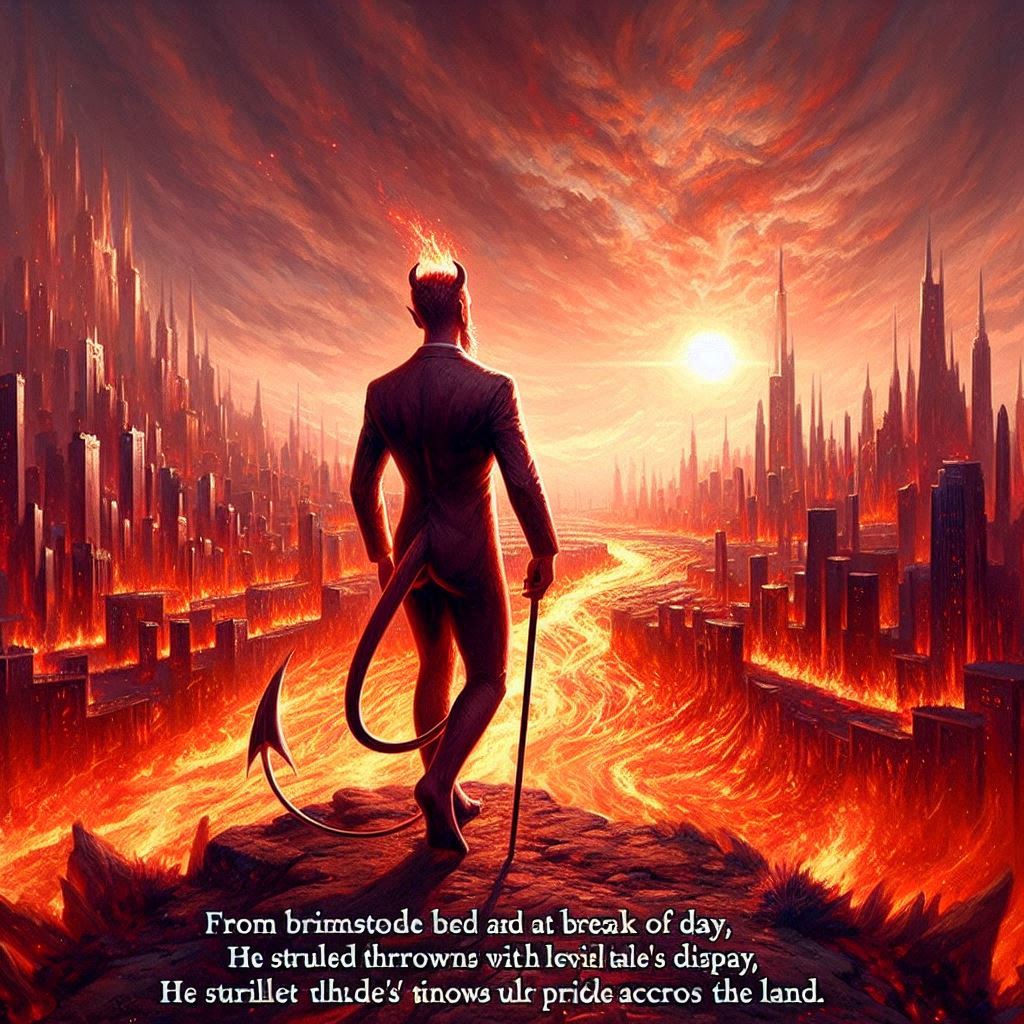
Robert Southey’s “The Devil’s Walk on Earth” is a satirical poem that imagines the Devil taking a stroll through the world to inspect his “farm” — a metaphor for human society. Written in the early 19th century, the poem is a biting critique of politics, religion, social hypocrisy, and moral corruption.
This poem is very long. To long for a song. I used Microsoft’s new AI called CoPilot to help me shorten it instead of ChatGPT. I really think I have been relying to AI to create and repurpose these Public Domain poems to much. Although I am having success with it on getting subscribers on YouTube and people do like the poem interpretations, I think that I have been overthinking things and – this platform, WordPress – is my personal blog. So if you are reading this, then you may be interested as me as a person instead of all of the AI Public Domain poetry that I have been making.
I really want this blog to be more about me, personally, and be my words – not some AI generated words. So if I use AI to write with, words that are not my own – I will use a different background than, this – my own personal writing and thoughts. So if you want to come back for ME, then this is me. If you want to hear AI generated public domain poetry, then go visit my YouTube channel.
Here is the video from my YouTube channel that breaks down this poem. You may want to read the poem first before you listen to the song. That is just my suggestion. Thanks for being here friends. :)
From his brimstone bed at break of day
A walking the Devil is gone,
To look at his snug little farm of the World,
And see how his stock went on.
Over the hill and over the dale,
And he went over the plain;
And backward and forward he swish’d his tail
As a gentleman swishes a cane.
How then was the Devil drest?
Oh, he was in his Sunday’s best
His coat was red and his breeches were blue,
And there was a hole where his tail came through.
A lady drove by in her pride,
In whose face an expression he spied
For which he could have kiss’d her;
Such a flourishing, fine, clever woman was she,
With an eye as wicked as wicked can be,
I should take her for my Aunt, thought he,
If my dam had had a sister.
He met a lord of high degree,
No matter what was his name;
Whose face with his own when he came to compare
The expression, the look, and the air,
And the character, too, as it seem’d to a hair,
Such a twin-likeness there was in the pair
That it made the Devil start and stare
For he thought there was surely a looking-glass there,
But he could not see the frame.
He saw a Lawyer killing a viper,
On a dung-hill beside his stable;
Ha! quoth he, thou put’st me in mind
Of the story of Cain and Abel.
An Apothecary on a white horse
Rode by on his vocation;
And the Devil thought of his old friend
Death in the Revelation.
He pass’d a cottage with a double coach-house,
A cottage of gentility,
And he own’d with a grin
That his favorite sin,
Is pride that apes humility.
He saw a pig rapidly
Down a river float;
The pig swam well, but every stroke
Was cutting his own throat;
And Satan gave thereat his tail
A twirl of admiration;
For he thought of his daughter War,
And her suckling babe Taxation.
Well enough, in sooth, he liked that truth
And nothing the worse for the jest;
But this was only a first thought
And in this he did not rest:
Another came presently into his head,
And here it proved, as has often been said
That second thoughts are best.
For as Piggy plied with wind and tide,
His way with such celerity,
And at every stroke the water dyed
With his own red blood, the Devil cried,
Behold a swinish nation’s pride
In cotton-spun prosperity.
He walk’d into London leisurely,
The streets were dirty and dim:
But there he saw Brothers the Prophet,
And Brothers the Prophet saw him.
He entered a thriving bookseller’s shop;
Quoth he, we are both of one college,
For I myself sate like a Cormorant once
Upon the Tree of Knowledge.
As he passed through Cold-Bath Fields he look’d
At a solitary cell;
And he was well-pleased, for it gave him a hint
For improving the prisons of Hell.
He saw a turnkey tie a thief’s hands
With a cordial tug and jerk;
Nimbly, quoth he, a man’s fingers move
When his heart is in his work.
He saw the same turnkey unfettering a man
With little expedition;
And he chuckled to think of his dear slave-trade,
And the long debates and delays that were made,
Concerning its abolition.
He met one of his favorite daughters
By an Evangelical Meeting:
And forgetting himself for joy at her sight,
He would have accosted her outright,
And given her a fatherly greeting.
But she tipt him the wink, drew back, and cried,
Avaunt! my name’s Religion!
And then she turn’d to the preacher
And leer’d like a love-sick pigeon.
A fine man and a famous Professor was he,
As the great Alexander now may be,
Whose fame not yet o’erpast is:
Or that new Scotch performer
Who is fiercer and warmer,
The great Sir Arch-Bombastes.
With throbs and throes, and ah’s and oh’s.
Far famed his flock for frightning;
And thundering with his voice, the while
His eyes zigzag like lightning.
This Scotch phenomenon, I trow,
Beats Alexander hollow;
Even when most tame
He breathes more flame
Then ten Fire-Kings could swallow.
Another daughter he presently met;
With music of fife and drum,
And a consecrated flag,
And shout of tag and rag,
And march of rank and file,
Which had fill’d the crowded aisle
Of the venerable pile,
From church he saw her come.
He call’d her aside, and began to chide,
For what dost thou here? said he,
My city of Rome is thy proper home,
And there’s work enough there for thee.
Thou hast confessions to listen,
And bells to christen,
And altars and dolls to dress;
And fools to coax,
And sinners to hoax,
And beads and bones to bless;
And great pardons to sell
For those who pay well,
And small ones for those who pay less.
Nay, Father, I boast, that this is my post,
She answered; and thou wilt allow,
That the great Harlot,
Who is clothed in scarlet,
Can very well spare me now.
Upon her business I am come here,
That we may extend our powers:
Whatever lets down this church that we hate,
Is something in favor of ours.
You will not think, great Cosmocrat!
That I spend my time in fooling;
Many irons, my sire, have we in the fire,
And I must leave none of them cooling;
For you must know state-councils here,
Are held which I bear rule in.
When my liberal notions,
Produce mischievous motions,
There’s many a man of good intent,
In either house of Parliament,
Whom I shall find a tool in;
And I have hopeful pupils too
Who all this while are schooling.
Fine progress they make in our liberal opinions,
My Utilitarians,
My all sorts of, inians
And all sorts of, arians;
My all sorts of, ists,
And my Prigs and my Whigs
Who have all sorts of twists
Train’d in the very way, I know,
Father, you would have them go;
High and low,
Wise and foolish, great and small,
March-of-Intellect-Boys all.
Well pleased wilt thou be at no very far day
When the caldron of mischief boils,
And I bring them forth in battle array
And bid them suspend their broils,
That they may unite and fall on the prey,
For which we are spreading our toils.
How the nice boys all will give mouth at the call,
Hark away! hark away to the spoils!
My Macs and my Quacks and my lawless-Jacks,
My Shiels and O’Connells, my pious Mac-Donnells,
My joke-smith Sydney, and all of his kidney,
My Humes and my Broughams,
My merry old Jerry,
My Lord Kings, and my Doctor Doyles!
At this good news, so great
The Devil’s pleasure grew,
That with a joyful swish he rent
The hole where his tail came through.
His countenance fell for a moment
When he felt the stitches go;
Ah! thought he, there’s a job now
That I’ve made for my tailor below.
Great news! bloody news! cried a newsman;
The Devil said, Stop, let me see!
Great news? bloody news? thought the Devil,
The bloodier the better for me.
So he bought the newspaper, and no news
At all for his money he had.
Lying varlet, thought he, thus to take in old Nick!
But it’s some satisfaction, my lad,
To know thou art paid beforehand for the trick,
For the sixpence I gave thee is bad.
And then it came into his head
By oracular inspiration,
That what he had seen and what he had said
In the course of this visitation,
Would be published in the Morning Post
For all this reading nation.
Therewith in second sight he saw
The place and the manner and time,
In which this mortal story
Would be put in immortal rhyme.
That it would happen when two poets
Should on a time be met,
In the town of Nether Stowey,
In the shire of Somerset.
There while the one was shaving
Would he the song begin;
And the other when he heard it at breakfast,
In ready accord join in.
So each would help the other,
Two heads being better than one;
And the phrase and conceit
Would in unison meet,
And so with glee the verse flow free,
In ding-dong chime of sing-song rhyme,
Till the whole were merrily done.
And because it was set to the razor,
Not to the lute or harp,
Therefore it was that the fancy
Should be bright, and the wit be sharp.
But, then, said Satan to himself,
As for that said beginner,
Against my infernal Majesty,
There is no greater sinner.
He hath put me in ugly ballads
With libelous pictures for sale;
He hath scoff’d at my hoofs and my horns,
And has made very free with my tail.
But this Mister Poet shall find
I am not a safe subject for whim;
For I’ll set up a School of my own,
And my Poets shall set upon him.
He went to a coffee-house to dine,
And there he had soy in his dish;
Having ordered some soles for his dinner,
Because he was fond of flat fish.
They are much to my palate, thought he,
And now guess the reason who can,
Why no bait should be better than place,
When I fish for a Parliament-man.
But the soles in the bill were ten shillings;
Tell your master, quoth he, what I say;
If he charges at this rate for all things,
He must be in a pretty good way.
But mark ye, said he to the waiter,
I’m a dealer myself in this line,
And his business, between you and me,
Nothing like so extensive as mine.
Now soles are exceedingly cheap,
Which he will not attempt to deny,
When I see him at my fish-market,
I warrant him, by-and-by.
As he went along the Strand
Between three in the morning and four
He observed a queer-looking person
Who staggered from Perry’s door.
And he thought that all the world over
In vain for a man you might seek,
Who could drink more like a Trojan
Or talk more like a Greek.
The Devil then he prophesied
It would one day he matter of talk,
That with wine when smitten,
And with wit moreover being happily bitten,
The erudite bibber was he who had written
The story of this walk.
A pretty mistake, quoth the Devil;
A pretty mistake I opine!
I have put many ill thoughts in his mouth,
He will never put good ones in mine.
And whoever shall say that to Porson
These best of all verses belong,
He is an untruth-telling whore-son,
And so shall be call’d in the song.
And if seeking an illicit connection with fame,
Any one else should put in a claim,
In this comical competition;
That excellent poem will prove
A man-trap for such foolish ambition,
Where the silly rogue shall be caught by the leg,
And exposed in a second edition.
    Now the morning air was cold for him
        Who was used to a warm abode;
    And yet he did not immediately wish,
        To set out on his homeward road.
    For he had some morning calls to make
        Before he went back to Hell;
    So thought he I'll step into a gaming-house,
        And that will do as well;
    But just before he could get to the door
        A wonderful chance befell.
        For all on a sudden, in a dark place,
    He came upon General ----'s burning face;
        And it struck him with such consternation,
    That home in a hurry his way did he take,
    Because he thought, by a slight mistake
        'Twas the general conflagration.
What Is the Poem About?
The Devil, dressed in his Sunday best, walks through towns and cities, observing people and institutions. What he finds is a world full of pride, vanity, greed, and deceit — all thriving under his influence. From lawyers and apothecaries to politicians and religious figures, Southey portrays nearly every facet of society as complicit in moral decay.
Key Themes and Meanings
- Satire of Human Institutions: Southey mocks the legal system, organized religion, political leaders, and even intellectual movements. The Devil finds these institutions not only familiar but often indistinguishable from his own methods.
- Hypocrisy and Pride: The Devil delights in seeing pride disguised as humility, religion used for manipulation, and political debates that serve selfish ends.
- Corruption and Influence: The Devil doesn’t need to corrupt the world — it’s already running smoothly under his values. He sees his “daughters” (like War and Religion) actively working in society, furthering his goals.
- Irony and Humor: The poem is rich with irony. For example, the Devil is surprised to see people who resemble him so closely, and he’s amused by how well his influence has taken root.
Why It Matters
Southey’s poem is more than just a humorous tale — it’s a sharp social commentary. By using the Devil as a lens, he exposes the flaws and contradictions in human behavior and institutions. The poem suggests that evil isn’t always dramatic or monstrous; often, it’s mundane, respectable, and woven into the fabric of everyday life.







 Married in Arkansas